





31 Jan Vivomer vs. PLA: Does Shellworks’ Breakthrough Represent the Future of Sustainable Cosmetic Packaging?
In a world of fast-moving beauty that is moving beyond “clean ingredients” and into a “packaging revolution.” Pioneering this is UK-based startup Shellworks – UK-based pioneer, Shellworks, has established itself as a global leader for its disruptive material, Vivomer.
But brands have been debating whether Vivomer, which is a commercially available packaging material, should be used along with the industry standard PLA (Polylactic Acid), and with that comes the question: what are these materials made of? Are they really the solution for beauty brands? More importantly, what are the secret trade-offs? We delve deeply into the science, advantages and disadvantages of Vivomer and PLA to help you make an informed brand choice.
5.1 Vivomer: Definition & Core Properties
Vivomer is not your traditional bioplastic. It comes from a family of substances called PHAs (Polyhydroxyalkanoates). The molecule’s polymeric nature may have been developed by microorganisms during development with the help of a number of nutrients: cellulose as an energy source and as a waste product.
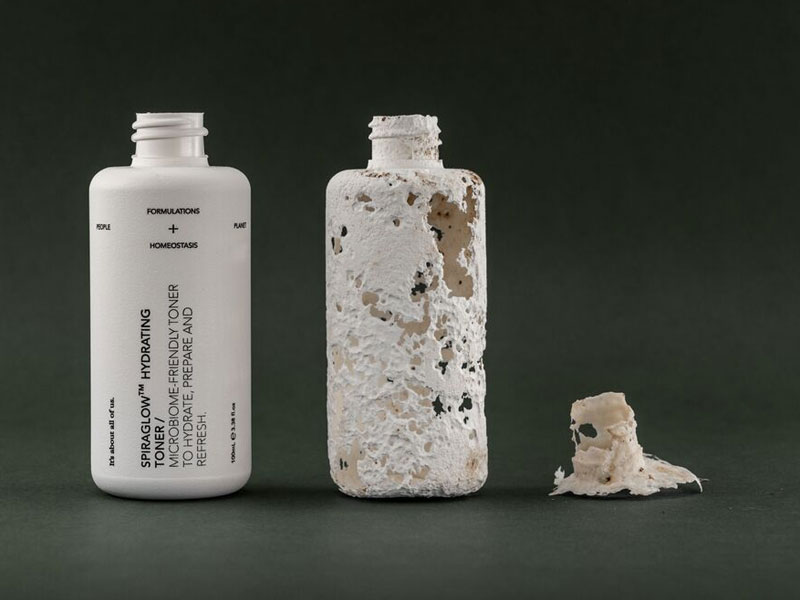
Unlike other petroleum-based plastics, Vivomer is grown rather than made. It can be made by microorganisms (bacteria) via fermentation. Consider it the fat that bacteria store for energy. Shellworks takes the material and processes it into a tough, plastic-like material that can be shaped into jars, tubes, and compacts.
5.2 Advantages of Vivomer
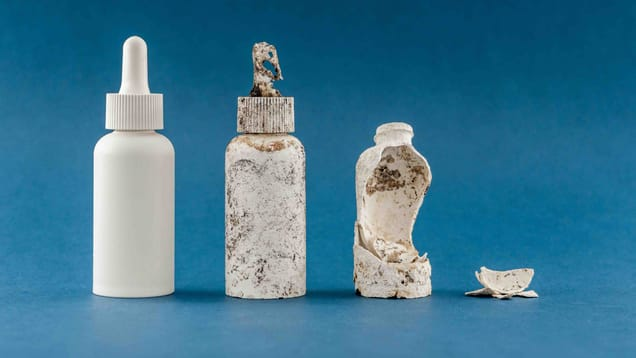
True Home Compostability: This is Vivomer’s “Superpower.” Unlike a lot of bio-plastics, it decomposes spontaneously in the compost that collects in a backyard, or in the soil or even in the marine environment without leaving behind microplastics.
Vegan & Fossil-Free: It’s produced solely by fermentation rather than burning fossil fuels.
Premium Aesthetic: Vivomer has a unique, matte, stone-like texture. It’s artisanal, highly-end-crafted, perfectly in line with luxury sustainable beauty brands.
5.3 The Achilles’ Heel: Vivomer’s Shortcomings in Cosmetics
While Vivomer is an ecological triumph, it faces major challenges in cosmetics:
Weak Moisture & Oil Barrier: This is the most severe problem. Because it’s engineered to break down in the presence of microbes and moisture, Vivomer is not suitable for water-heavy formulas such as lotions or certain essential oils. When left for a while, the packaging can soften or cause the product to evaporate.
Shelf Life: Most cosmetics require a 2–3 year shelf life. Vivomer is bio-active, but since it’s bio-active, it can start to degrade faster than anticipated in environments such as inside a house, where the temperature is too high or humid to store, which can interfere with global shipping and long-term retail storage.
No Transparency: Vivomer, in the current situation, is very opaque. Brands looking to show off the color or texture of their formulas (serums, perfumes) will find this material hard to achieve the clear PET or glass-like clarity.
Production Cost: Because of the difficulty of the fermentation process on PHA and small volume production, Vivomer is expensive (even for small-scale plants) and more expensive than even the most sophisticated plastic or PLA.
5.4 PLA: The Bio-Plastic Old Guard
PLA (Polylactic Acid) is perhaps the most ubiquitous bioplastic now, commonly made from fermented plant starch like corn or sugarcane.
Pros of PLA
High Transparency – PLA is very transparent – it can be made nearly clear, meaning brands can keep their traditional “plastic” appearance while sourcing from plant-based sources.
Cost-Effective & Scalable: PLA supply chain is mature, which makes PLA much more affordable than PHA-based materials such as Vivomer.
Process Compatibility: Compatibility of this material with existing injection molding and blow molding machinery facilitates manufacturers.
The Drawbacks of PLA
The Industrial Composting Myth: PLA is marketed as “biodegradable,” but it is not going to decompose in your garden or oceans. It needs industrial composting (60 °C+ temperatures) to decompose. If it enters a landfill, it will last nearly as long as regular plastic.
Heat Sensitivity: PLA has a very low melting temperature. PLA packaging can warp or deform when a shipping container becomes too hot in transit.
Brittle: It is less tough than traditional PP or PET, and less appropriate for sophisticated moving parts such as pump heads.
5.5 Head-to-Head: Vivomer vs. PLA
| Feature | Vivomer (PHA) | PLA (Polylactic Acid) |
| Source | Bacterial Fermentation | Plant Starch (Corn/Cane) |
| Degradation | Home, Soil, Marine | Industrial Compost Only (Limited) |
| Clarity | Opaque/Matte | High Transparency |
| Barrier Property | Moderate to Low | Moderate |
| Cost | Premium/High | Mid-range |
| Best For | Balms, Solids, Luxury Eco-Brands | Mass-market Clear Containers |
5.6 Final Judgment: What Brand Do You Choose?
For beauty brands, the choice will be based on your level of sustainability maturity; for example, if the brand statement is “Zero Waste” and “Circular Beauty,” Vivomer is the gold standard for environmental integrity. It is tailored for solid products (such as lip balms or deodorant sticks) that require no transparency and can tolerate a premium price tag.
Pick PLA if you need a transitional material with a nice, clear, yet cost-efficient way to shift your customer’s focus towards industrial composting.
Conclusion
Shellworks’ Vivomer is, at its core, a “nature-first” technology. The current limitations in its effectiveness in the cosmetic industry—primarily the tension between “rapid degradation” and “product shelf-life”—are the frontiers of contemporary R&D. While barrier technology advances, we will certainly see materials like Vivomer disappear like a fallen leaf and be set to usher in the future of beauty.
At Nicer Packaging, we work at the heart of material science to guide your brand toward a green revolution. Please reach out to us to explore the best sustainable substrate for your next product launch today.