





05 Nov Dual-Chamber PE Tubes: Why Uneven Dispensing Matters
A dual-chamber tube promises a simple routine: squeeze once, receive two formulas, and mix them just before application. The difficulty begins when one formula comes out readily while the other barely appears. Squeezing again can leave the customer with even more of the first component and still too little of the second.
For brands considering dual-chamber PE tubes, this is a packaging selection issue that deserves attention before artwork approval. Keeping formulas apart during storage and delivering them in a useful proportion are separate requirements.
Our recommendation: if a two-formula product needs a consistent dispensing ratio, do not approve a tube-in-tube pack that repeatedly produces an unbalanced dose during normal use. Evaluate a dual-chamber airless system with specified dosing alongside the tube, then compare both using the intended formulas.
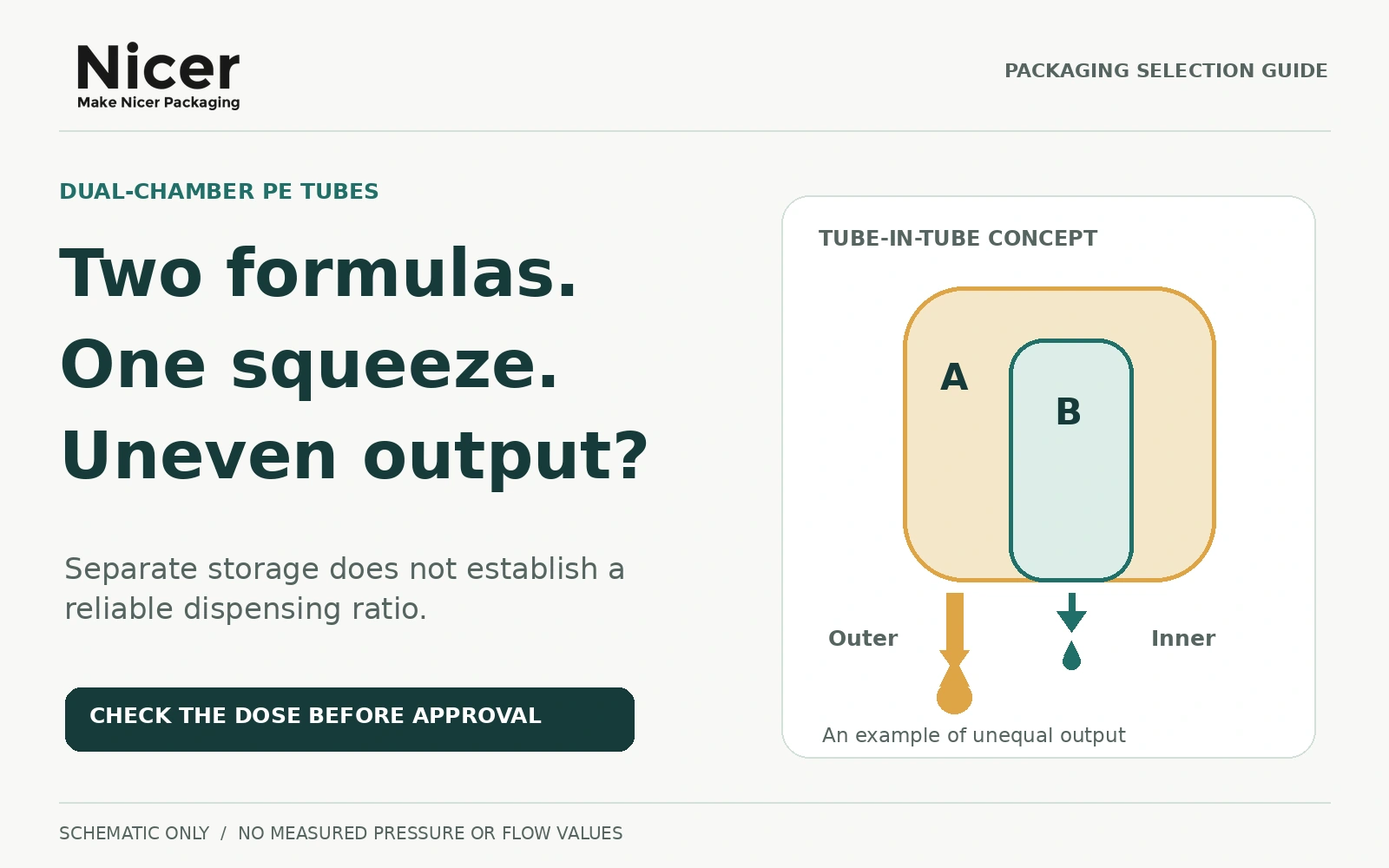
Double-layer PE tubes and dual-chamber tubes mean different things
A tube can have multiple layers in its wall while holding only one formula. A dual-chamber tube has two separate product reservoirs. A tube-in-tube design places one reservoir inside the other; other dual-chamber designs use compartments alongside each other.
This guide focuses on the nested, tube-in-tube squeeze format. Its dispensing behaviour should not be assumed to represent every multilayer PE tube or every dual-chamber construction. When requesting samples, ask for a section drawing that identifies the reservoirs and their separate paths to the outlet.
When the outer formula comes out before the inner formula
Consider a pack containing a cream in the outer reservoir and a second formula in the inner tube. The user squeezes the outside of the pack. The outer cream starts flowing, but the inner formula does not start, or appears only in a very small amount.
A plausible explanation for this failure pattern is that the outer tube can accommodate the squeeze by deforming and releasing its own contents. This does not require a corresponding reduction in the inner reservoir’s volume. The load reaching the inner tube may be insufficient to deform it enough and drive its formula through its dispensing path.
The outer wall’s movement therefore gives no direct assurance of adequate inner-tube compression. The practical result can be an outer chamber that dispenses easily and an inner chamber that remains reluctant to dispense.
This explanation describes a possible failure mechanism, rather than a measured pressure distribution or an inevitable sequence in every tube. Wall flexibility, formula flow behaviour and outlet resistance all matter. A published multi-chamber tube patent identifies chamber deformation, relative viscosity, outlet geometry and applied pressure as factors in dispensing. A proposed design is useful engineering context; its existence does not validate a particular filled pack.
Why squeezing harder can make the dose less balanced
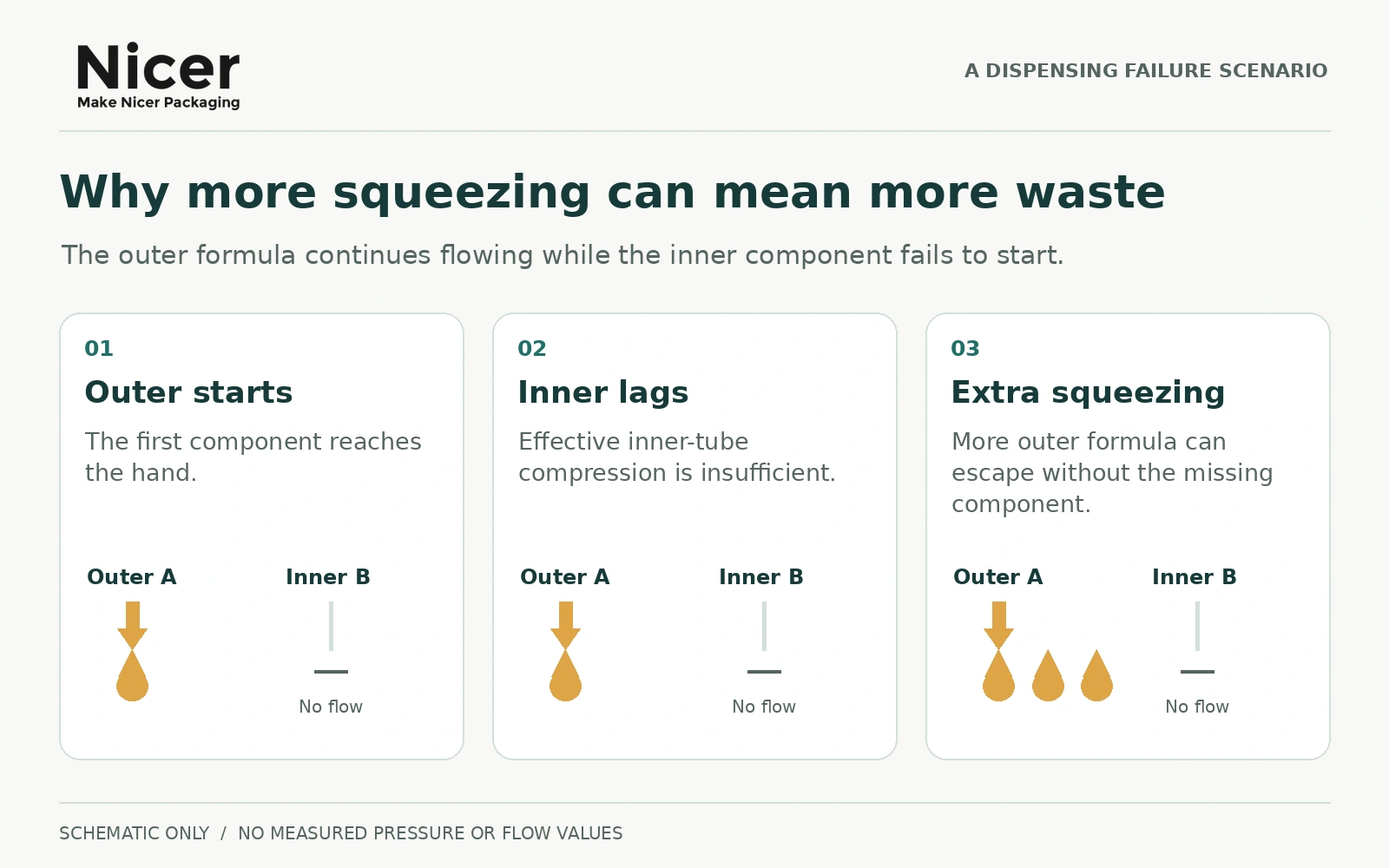
The natural response to a missing component is to squeeze again. If the outer chamber continues dispensing while the inner tube remains insufficiently compressed, that response adds more of the component the customer already has.
- The outer formula reaches the hand first.
- The customer applies more force or changes grip to obtain the inner formula.
- More outer formula escapes before enough inner formula appears.
Eventually seeing both formulas at the outlet does not, by itself, restore the intended ratio of the complete dose. The customer may have to use too much product, discard the excess or accept an uncertain mixture. A short demonstration showing both colours flowing can miss this problem.
For a product sold on the convenience of combining two formulas, repeated squeezing and grip adjustments are a substantial weakness. If unequal dispensing continues, one reservoir may also become depleted before the other.
What real customer feedback tells packaging buyers
The concern extends beyond whether two streams appear together. Customers also notice how much effort it takes to retrieve the product they bought.
d’Alba describes its White Truffle Double Moisture Cream as a serum and cream combined in one tube. In an iHerb review dated February 28, 2026, a reviewer named Lana, marked as a verified purchaser, praised the moisturiser but described the tube as hard to squeeze. The reviewer reported being unable to dispense the remaining cream after substantial use and opening the tube to retrieve it.
That is one person’s account, and the same page includes positive feedback. It is not a measured residual-product test, evidence of a failure rate, or confirmation of the tube’s polymer construction. It does, however, identify a useful purchasing question: can an ordinary user continue accessing the product as the pack empties?
For a dual-formula pack, that question applies to both reservoirs. Approval should cover first use, repeated daily dispensing and the final usable doses.
Changing the PE material alone is not a dispensing specification
A softer wall may change how a tube deforms, but a request for softer PE does not define how much formula each chamber should deliver. The project still needs a target ratio, an acceptable range and a method for checking it.
Review the inner and outer wall specifications together with the reservoir geometry, formula flow behaviour, nozzle passages and filling conditions. Ask what changes are proposed and how their effect will be demonstrated with filled samples. Increasing or decreasing wall thickness without checking the resulting dose can move the problem rather than resolve it.
Reservoir capacity and dispensing ratio also need separate consideration. Two chambers with equal nominal capacity do not establish equal output from every squeeze.
When a dual-chamber airless bottle deserves priority
When a product depends on a repeatable proportion of two components, a dual-chamber airless bottle with defined dosing is a sensible candidate for comparison. It gives the buyer a different set of controls to specify: the dose from each pump, the actuation arrangement and the behaviour of the two reservoirs through use.
For example, Aptar’s Neomix technical page describes a dual-chamber airless format with separate formula storage and product-specific co-dispensing. This is an example of a specified dispensing architecture, rather than evidence that any bottle labelled dual airless will deliver the ratio a brand requires.
For the buyer, the key questions are practical:
- Does one complete press actuate both dispensing mechanisms, or does the consumer operate two pumps separately?
- What is the nominal dose from each side, and what variation is acceptable?
- How many initial actuations are required before both formulas dispense correctly?
- Do both reservoirs remain usable through the agreed end point?
Two independently operated pumps allow separate dosing; they do not establish an automatic mixing ratio. A shared actuator also needs testing with full, partial and off-centre presses under the intended instructions.
Pump packaging still needs validation
Consumer feedback provides a reason to keep that requirement explicit. In a LovelySkin review of SkinMedica TNS Advanced+ Serum dated March 17, 2025, a verified purchaser using the name Cdub82 reported receiving one component at the start and a different imbalance near the end. This is an individual report about a particular product and packaging version, not an assessment of every dual-chamber pump system.
Our preference for a specified dual-chamber airless system is conditional on its filled-pack performance. Compare the quoted cost, filling requirements, priming behaviour, dose consistency and remaining product. The airless label alone is insufficient grounds for approval.
How to test dual-chamber PE tubes before production
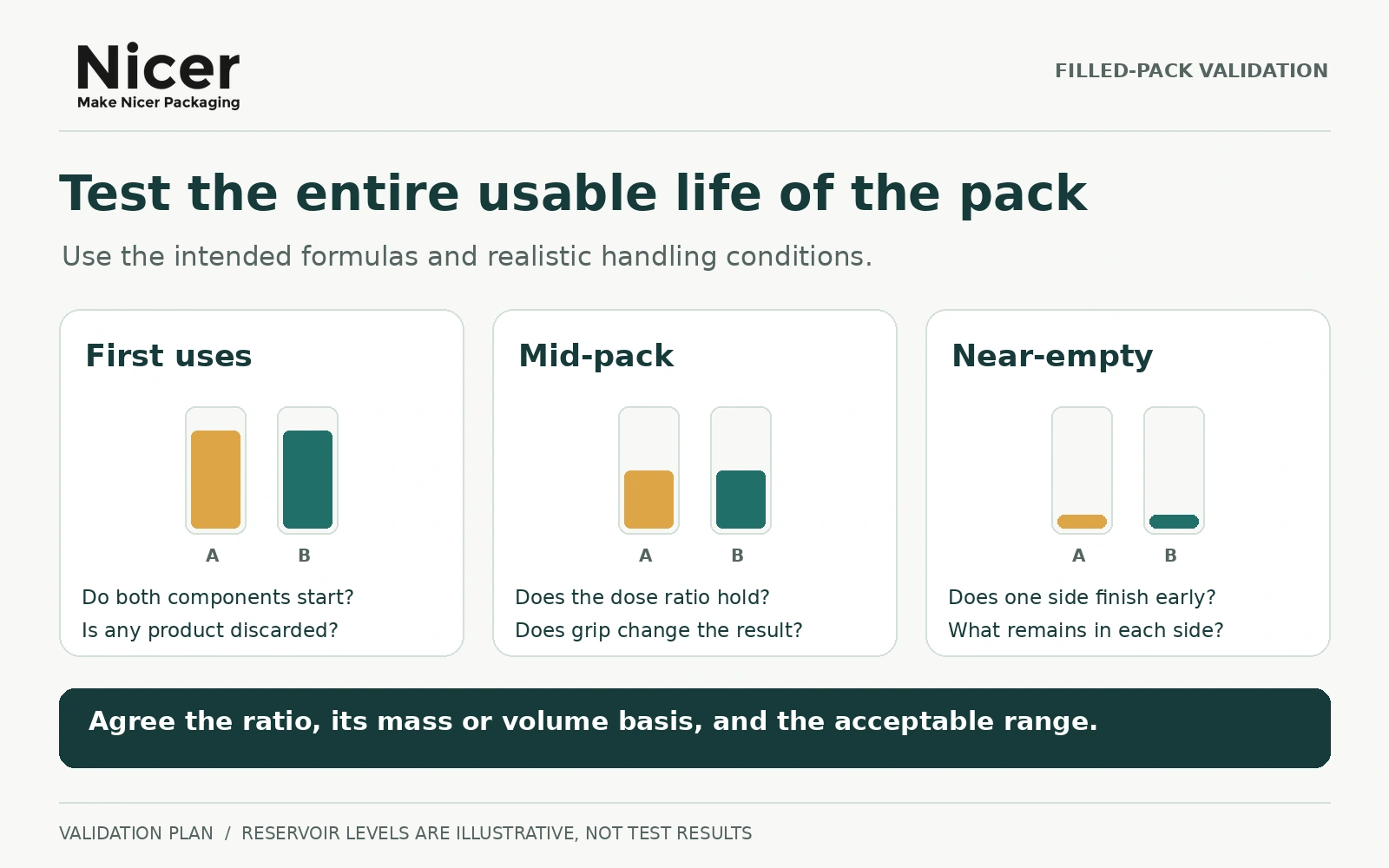
Start by agreeing what the finished product must deliver. The formulator should define the target component ratio, whether it is based on mass or volume, and the acceptable variation. A decorative two-colour effect and a formulation that depends on a controlled proportion require different acceptance criteria.
Use the intended formulas in production-representative packs, with the proposed filling and sealing process. Run the tube and the alternative dispensing system through the same agreed use conditions.
| Stage | What to check | What the result should reveal |
|---|---|---|
| Initial use | Record what comes from each outlet during the first uses, following the proposed instructions. | Any one-sided start, delayed component or product discarded before an acceptable dose. |
| Normal handling | Include different users, ordinary grip positions and realistic squeeze or press actions. | Whether correct dosing depends on a special technique. |
| Repeated dispensing | Measure the component ratio at intervals through the usable life of the pack. | Whether performance drifts as the reservoirs empty. |
| Storage and pauses | Use agreed orientations, temperatures and periods between applications. | Whether restarting changes output, residue or operating effort. |
| Near-empty use | Record the last acceptable doses and remaining material in each reservoir. | Early depletion of one component or inaccessible product. |
| Pack condition | Check seals, closures, leakage and unwanted contact between stored formulas. | Whether dispensing performance is accompanied by acceptable containment. |
Where the outlet design permits, collect and weigh the two components separately without changing the dispensing path. If they merge before collection, agree a suitable analytical method with the formulator. A photograph of two colours is not a ratio measurement. If the target is volumetric, account for the two formulas’ densities when interpreting weights.
Keep the results for each pack and use stage. An acceptable average can conceal an outer-heavy first dose and an inner-heavy final dose that customers experience separately.
What to include in a packaging enquiry
A useful brief lets the supplier review the dispensing requirement before recommending a structure. Include:
- The two formula types and available flow or viscosity information, including the measurement conditions.
- The target ratio, its mass or volume basis, and the acceptable dose range.
- The total fill and proposed allocation between reservoirs.
- The intended use instructions, storage conditions and expected interval between applications.
- The estimated order quantity, decoration requirements and sample-testing plan.
If a sample already shows outer-first dispensing, describe that sequence explicitly. Ask the supplier to address it with the actual formulas and demonstrate the proposed improvement through repeated use.
Our recommendation for two-formula skincare packaging
We would not recommend a tube-in-tube squeeze pack for a ratio-sensitive product when normal use repeatedly produces excess outer formula and insufficient inner formula. Consumers should be able to obtain an acceptable dose by following straightforward instructions.
A tube remains an option when the filled pack demonstrates suitable dispensing and usability for the intended product. Where it cannot do so, give priority to evaluating a dual-chamber airless system with defined dosing, or another arrangement the formulator can validate.
Nicer Packaging supplies custom cosmetic tubes and airless bottle packaging. Send us your packaging brief, including both formula types, the required ratio and the dispensing problem you need to solve. We can review available packaging routes with you; any specific dual-chamber configuration and its suitability need confirmation through sample evaluation.